
TL;DR:
- Media IP refers both to transporting audiovisual data over IP networks and to the legal rights protecting media content. Understanding these distinctions is essential for designing scalable production infrastructures and managing rights effectively across platforms. Proper alignment of media transport technology and intellectual property rights is crucial for successful, compliant digital content strategies.
Media IP is the method of transporting video, audio, and related data as packets over an Internet Protocol network, and it is also shorthand for the intellectual property rights that protect media content. Both meanings carry real weight for marketing professionals and content creators, yet the two are frequently conflated. Understanding media IP in either sense shapes how you produce, distribute, and protect content at every stage of a campaign or production. This guide separates the two definitions clearly and explains what each one means for your digital content strategy.
What is media IP transport and how does it work?
Media IP transport is the process of converting audiovisual signals into data packets and sending them across standard IP networks rather than through dedicated cabling. The result is a production infrastructure that behaves more like a computer network than a traditional broadcast facility. Instead of running separate coaxial cables for every video feed, a single network switch can carry hundreds of simultaneous streams to any connected endpoint.

The contrast with legacy systems is stark. Traditional Serial Digital Interface (SDI) cabling connects one source to one destination in a fixed, point-to-point arrangement. Reconfiguring an SDI setup means physically rerouting cables. With AV over IP, any source can reach any destination through software configuration alone, enabling distribution to any number of endpoints using standard network infrastructure.
Two standards govern professional media IP transport. SMPTE ST 2022 handles the encapsulation and forward error correction of compressed video over IP. SMPTE ST 2110 goes further by separating video, audio, and metadata into distinct synchronised flows, allowing each essence to travel independently and be reassembled at the receiver. Panasonic and LANG are among the manufacturers actively driving ST 2110 adoption across broadcast facilities. This separation matters because it gives engineers granular control over each element of a production signal.
The scalability benefit is significant for content teams. A marketing team producing live social content across TikTok and YouTube simultaneously can route multiple camera feeds, graphics sources, and audio channels through a single managed network rather than investing in separate hardware paths for each output.
- ST 2110 supports separate synchronised flows of video, audio, and metadata
- Standard IT switches and routers replace proprietary broadcast routing hardware
- Software-defined routing allows instant reconfiguration without physical rewiring
- Multi-vendor interoperability reduces dependency on a single equipment supplier
- Integration with cloud platforms becomes practical when content already exists as IP packets
Pro Tip: When specifying a media IP network for a production, prioritise network switch quality and timing infrastructure over encoding hardware. The AVIXA guidance on AV over IP confirms that deployment success depends more on network quality factors than on the encoding equipment itself.
How does a media IP address work in professional AV networks?
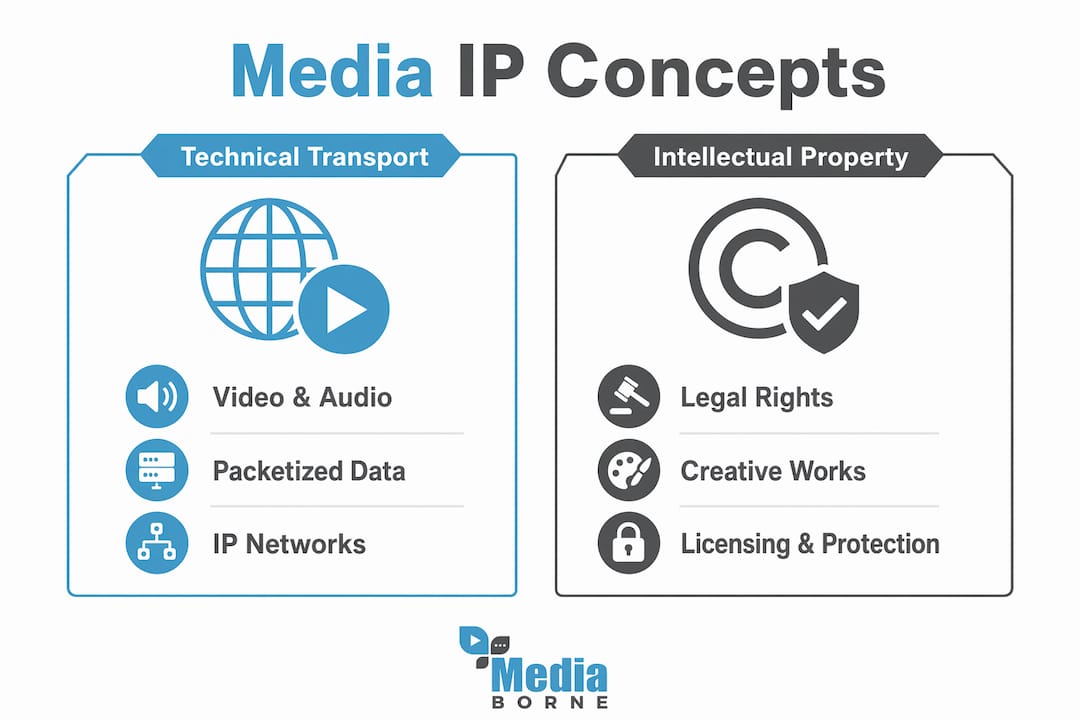
A media IP address is the network address assigned to the stream of RTP (Real-time Transport Protocol) packets carrying the actual audio or video essence. It is distinct from the signalling IP address, which handles session setup and control messages such as SIP packets. Confusing the two is a common source of misconfiguration in professional AV environments.
The table below summarises the key differences between signalling and media IP addresses in a professional context.
| Parameter | Signalling IP address | Media IP address |
|---|---|---|
| Purpose | Session setup and control | Carries audio/video essence |
| Protocol | SIP, NMOS IS-04/05 | RTP/RTCP |
| Traffic type | Low bandwidth, intermittent | High bandwidth, continuous |
| Routing requirement | Standard unicast | Often multicast |
| Latency sensitivity | Moderate | Very high |
Multicast routing is the preferred delivery method for media IP streams in professional facilities. Rather than sending a separate copy of a stream to each receiver, multicast sends one stream that multiple receivers join simultaneously. This dramatically reduces network load when the same camera feed needs to reach a vision mixer, a monitor wall, and a recording server at the same time.
Quality of Service configuration is non-negotiable in these environments. Network switches must be configured to prioritise media traffic over general data traffic, otherwise packet delays cause visible artefacts or audio dropouts. Timing accuracy is equally critical. ST 2110 relies on IEEE 1588 Precision Time Protocol to synchronise all devices on the network to within microseconds of each other.
Pro Tip: If you are a content creator moving into IP-based production, ask your broadcast engineer to walk you through the network diagram before a live shoot. Knowing which IP address carries your programme audio versus your talkback circuit prevents costly errors during transmission.
What is media intellectual property and why does it matter?
Media intellectual property refers to the legal rights that protect original creative works. Intellectual property rights in the media and entertainment industry cover four main categories: copyright, trademarks, patents, and trade secrets. Each serves a different protective function and carries different commercial implications.
Copyright is the most relevant right for content creators. It attaches automatically to original works including films, music recordings, scripts, photographs, and written content at the moment of creation. The copyright owner controls reproduction, distribution, public performance, and the creation of derivative works. For a marketing team commissioning a brand film, this means the contract must explicitly assign copyright to the brand, otherwise the production company retains it by default.
Trademarks protect brand identifiers such as logos, slogans, and show titles. A media company that builds a recognisable format or series name should register the trademark to prevent competitors from using confusingly similar branding. Patents apply less frequently in media but cover proprietary technology used in production or distribution. Trade secrets protect confidential business information such as show formats, production formulas, and audience data models, and they require no formal registration but demand active measures to maintain secrecy.
The commercial logic behind IPR is straightforward. Rights transform creative content into assets that can be licensed, syndicated, or sold globally, securing revenue and incentivising further creativity. A format like a branded entertainment series becomes a licensable property once the IP is properly documented and protected. This is precisely the model that Media Borne applies when developing its own entertainment IP alongside client work.
For marketing professionals managing digital assets, understanding which rights you own, which you have licensed, and which you have inadvertently infringed is a baseline competency. Using a piece of music in a campaign video without the appropriate synchronisation licence, for example, can result in the video being removed from YouTube or Facebook within hours of publication.
How does understanding both concepts shape your content strategy?
Media over IP fundamentally changes production and distribution architectures, enabling unprecedented flexibility but increasing reliance on network engineering. For content strategists, this shift has direct workflow implications. Productions that once required a physical broadcast truck can now be orchestrated from a laptop connected to a managed network, provided the IP infrastructure is correctly specified.
Consider a brand running a live shopping event across multiple platforms simultaneously. The production team uses an ST 2110 network to route camera feeds, graphics, and presenter audio through a software vision mixer. The output streams are then encoded and pushed to TikTok, YouTube, and a proprietary e-commerce platform in parallel. This is a practical example of IP-based production workflows delivering commercial outcomes at scale.
Rights management sits alongside this technical capability. A multi-platform global distribution strategy creates a complex web of licensing obligations. Music rights, talent agreements, location releases, and format licences all carry territorial and platform-specific restrictions. Failing to map these before distribution can result in content being blocked in key markets.
Here is a practical framework for aligning media IP transport and intellectual property management within a content strategy:
- Audit your rights position before production begins. Identify every asset you plan to use and confirm you hold the appropriate licence or ownership for each platform and territory.
- Specify your network infrastructure early. If the production involves live IP transport, involve a broadcast engineer at the brief stage, not after the shoot schedule is set.
- Document IP ownership in every production contract. Specify who owns the master recording, the format, the underlying music, and any bespoke graphics created for the project.
- Plan for multi-platform delivery at the encoding stage. Different platforms have different codec, resolution, and latency requirements that affect how IP streams are configured.
- Review emerging trends in media IP infrastructure. Cloud-based IP production environments are reducing the cost of entry for brands that want broadcast-quality output without owning physical facilities.
Coordination between content creators, legal teams, and AV technologists is the single most common gap in digital content operations. Investing in content IP as a long-term asset requires both the technical capability to deliver it and the legal framework to protect and monetise it.
Key takeaways
Media IP covers two distinct but equally important domains: the technical transport of audiovisual content over IP networks and the legal rights that protect media content as intellectual property.
| Point | Details |
|---|---|
| Two meanings, one term | Media IP refers to both AV transport technology and intellectual property rights; context determines which applies. |
| SMPTE ST 2110 is the standard | ST 2110 separates video, audio, and metadata into synchronised flows for professional interoperable media networks. |
| Network quality drives success | QoS, multicast routing, and timing accuracy matter more than encoding hardware in media IP deployments. |
| Copyright attaches automatically | Original media works are protected by copyright at creation; contracts must explicitly assign ownership to avoid disputes. |
| Rights and infrastructure must align | Effective content strategy requires both a correctly specified IP network and a clear rights management framework. |
Why most content teams are only solving half the problem
The conversations I have with marketing and production teams almost always reveal the same blind spot. They have invested in the creative side, the cameras, the editing suite, the distribution platforms, and they have a reasonable grasp of intellectual property basics. What they consistently underestimate is the infrastructure layer that sits between production and delivery.
Media over IP is not a niche broadcast concern. It is the architecture that determines whether a live brand event reaches 50,000 viewers cleanly or drops frames at the worst possible moment. I have seen campaigns with six-figure production budgets undermined by a network switch that was never configured for multicast. The technical and the creative are not separate disciplines. They are the same problem viewed from different angles.
The intellectual property side has its own version of this gap. Most content teams know that copyright exists. Far fewer have a systematic process for auditing rights before distribution, particularly when content is being repurposed across platforms or territories. A piece of content that is fully cleared for a UK YouTube campaign may carry music rights that block it in Germany or trigger a Content ID claim in the United States.
My advice is to treat both media IP transport and intellectual property rights as strategic infrastructure, not administrative detail. The brands that build durable media assets are the ones that understand what they own, how it travels, and who controls it at every point in the chain. That combination of technical and legal literacy is what separates a one-off campaign from a scalable content operation.
— Stephen
How Media Borne can support your media IP strategy
Media Borne combines creative production with a deep understanding of IP-based workflows, making it a practical partner for brands that want broadcast-quality content without the complexity of managing it alone.
Whether you are producing a live social commerce event, a branded entertainment series, or a multi-platform campaign, Media Borne's video production services are built around IP-native workflows that scale with your ambitions. The team also supports clients in structuring content ownership and rights documentation from the outset, so the assets you create retain commercial value long after the campaign ends. If you are ready to build media that works harder and lasts longer, Media Borne is the place to start.
FAQ
What does media IP mean?
Media IP has two meanings: it refers to the transport of video and audio as data packets over an IP network, and it is also shorthand for intellectual property rights protecting media content. Context determines which definition applies.
What is a media IP address?
A media IP address is the network address assigned to the RTP stream carrying actual audio or video essence. It differs from a signalling IP address, which handles session setup and control rather than content delivery.
What is SMPTE ST 2110?
SMPTE ST 2110 is a suite of standards for professional transmission of video, audio, and ancillary data over IP networks. It separates each essence into independent synchronised flows, enabling scalable and interoperable media systems.
Is media over IP the same as internet streaming?
No. Media IP networks in professional contexts are typically private, engineered environments with strict Quality of Service controls. Consumer internet streaming prioritises reach over the precise timing and reliability that professional production requires.
How do intellectual property rights affect content distribution?
IPR enables media owners to control reproduction, distribution, and monetisation of their content. Marketing teams must confirm they hold the correct licences for every platform and territory before distributing any content asset.