

TL;DR:
- Narrative marketing uses storytelling to shape brand perception, foster emotional engagement, and build customer loyalty. It centers on customer stories and a five-part architecture to communicate transformation and position the brand as a helpful guide. Regularly reviewing narrative pillars and measuring emotional impact ensures long-term brand strength and differentiation.
Narrative marketing is the strategic use of storytelling to shape brand perception, create emotional engagement, and drive long-term customer loyalty. Unlike traditional advertising, which pushes a product message, narrative marketing pulls audiences into an ongoing story where they see themselves as the central character. Brands that master this approach, from Nike to Patagonia, build communities rather than just customer lists. This guide to narrative marketing covers the foundational tools, the architecture of a compelling brand story, practical strategies across channels, and how to measure what is working.
What are the essential prerequisites for narrative marketing?
Every effective narrative marketing strategy starts with narrative pillars. Most brands need 3–5 narrative pillars to organise their storytelling and reinforce a consistent transformation message. Think of pillars as the recurring themes your brand returns to across every piece of content, whether that is a TikTok video, a blog post, or a live event.

Alongside pillars, micro-stories are your most practical day-to-day tool. Micro-stories are short narrative snippets, typically 2–10 sentences, drawn from lived experience to make abstract ideas relatable. A customer describing how a product changed their morning routine is a micro-story. It is specific, human, and far more memorable than a feature list.
The table below compares the core tools and frameworks used in narrative marketing, along with their primary function.
| Tool or framework | Primary function | Best used for |
|---|---|---|
| Narrative pillars | Organise recurring brand themes | Long-term content consistency |
| Micro-stories | Make abstract ideas concrete | Social media, email, short video |
| Content calendar | Plan story sequencing across channels | Campaign coordination |
| Storytelling workshops | Align internal teams on brand voice | Onboarding, rebrands |
| Data analytics platforms | Measure sentiment and brand recall | Narrative performance review |
Beyond tools, you need internal alignment. Your sales team, content creators, and leadership must all tell the same story. Without that, your narrative fractures across touchpoints and confuses your audience.
Pro Tip: Review your narrative pillars every 6–12 months. Markets shift, and a pillar that resonated two years ago may now feel outdated or misaligned with where your audience is heading.
How do you develop a compelling brand narrative?
The most effective brand narratives centre on the buyer's journey, not your product features. A proven framework for building that narrative is the five-part narrative architecture: Old World, Shift, Monsters, New World, and Guide.
- Old World: The familiar reality your audience currently lives in.
- Shift: The change in the market or world that makes the old reality inadequate.
- Monsters: The obstacles, fears, or frustrations standing between your audience and progress.
- New World: The better future your audience wants to reach.
- Guide: Your brand, positioned as the experienced ally helping them get there.
The Shift is the engine of the story. It creates urgency and explains why the audience cannot simply stay where they are. For a brand like Slack, the Shift was the collapse of email as a functional team communication tool. The Monsters were missed messages, siloed information, and wasted hours. Slack positioned itself as the Guide into a New World of connected, real-time collaboration.
Customers must be the protagonist in brand stories, with the brand acting as guide. Making the brand the hero is the single most common mistake in narrative marketing. When Apple ran its "Think Different" campaign, the heroes were Einstein, Picasso, and Amelia Earhart. Apple was the Guide that helped creative people do what they were born to do.
Here are the key steps to build a cohesive story arc:
- Define your audience's Old World in their own language, using customer interviews or reviews.
- Identify the Shift. What has changed in the market, in culture, or in technology that makes the old way obsolete?
- Name the Monsters specifically. Vague frustrations do not create emotional resonance.
- Paint the New World in concrete, sensory terms. What does life look like after the transformation?
- Position your brand as the Guide with proof. Use case studies, testimonials, and data as evidence.
- Test your story arc with a small audience before scaling it across channels.
Real customer stories are your most powerful proof points. A single testimonial that maps directly onto the five-part architecture will outperform a polished brand video that focuses on product specifications.
Pro Tip: Write your brand narrative from the customer's perspective first. If you cannot describe their Old World in language they would use themselves, your story will feel generic and unconvincing.
What are practical narrative marketing strategies across channels?
Narrative marketing works across every channel, but the story must be adapted, not just copied, for each format. A campaign structured like a television season, with a premiere, episodic content, and a finale, builds narrative momentum that a single ad can never achieve. Each episode deepens the audience's investment in the story and the brand.
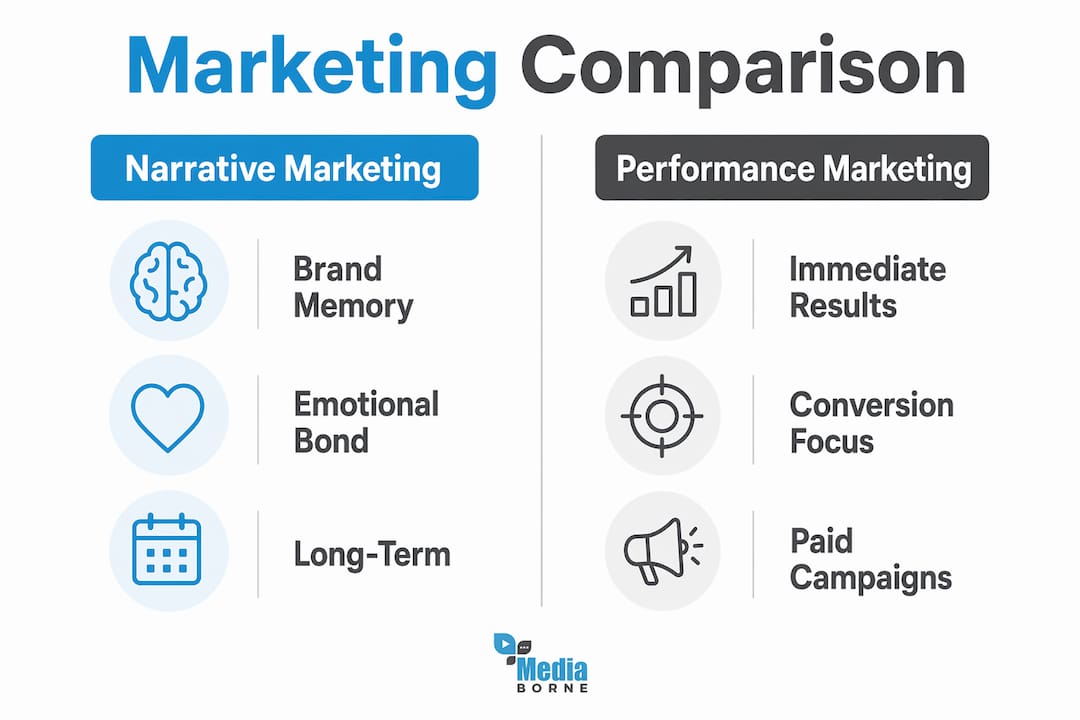
The distinction between narrative marketing and performance marketing is critical to understand. Marketing pushes transactions, while storytelling pulls audiences into ongoing narratives and builds demand. Performance marketing distributes your narrative. Narrative marketing creates the story worth distributing. Both are necessary, but they serve different functions and should be measured differently.
Practical techniques for applying narrative marketing across channels include:
- Episodic content: Release story-driven content in sequences on YouTube or TikTok, where each piece builds on the last.
- Micro-stories on social media: Share brief, specific customer moments on Instagram or LinkedIn rather than broad brand statements.
- Emotional hooks in video: Open with the Shift or a Monster, not a product shot, to create immediate relevance.
- Blog series: Structure long-form content as chapters in a larger brand story, linking each post to the next.
- Live events and shows: Use live formats to place your audience inside the New World, letting them experience the transformation directly.
The table below compares narrative marketing and performance marketing across key dimensions.
| Dimension | Narrative marketing | Performance marketing |
|---|---|---|
| Primary goal | Brand memory and emotional connection | Immediate clicks and conversions |
| Key metric | Sentiment, recall, share-of-voice | Cost per click, conversion rate |
| Time horizon | Long-term brand equity | Short-term campaign results |
| Content format | Stories, series, episodic content | Ads, landing pages, retargeting |
| Audience relationship | Community and loyalty | Transaction-based |
Media borne's approach at its core reflects this distinction. The company builds original content formats and entertainment-led campaigns precisely because audiences remember stories, not interruptions. You can see this thinking applied in social media campaigns that convert by combining narrative depth with performance distribution.
Pro Tip: Map your narrative content to buyer journey stages. Awareness content should introduce the Shift. Consideration content should name the Monsters. Decision content should show the New World with proof.
How can you measure the impact of narrative marketing?
Storytelling optimises for sentiment, recall, and share-of-voice, rather than immediate conversions. This is the most important expectation to set before you begin. If you measure a narrative campaign by click-through rates alone, it will always look like it underperforms.
Narrative marketing builds memory equity, which creates pricing power and turns customers into evangelists. Memory equity means your brand occupies a specific, emotionally charged position in your audience's mind. That position is what drives word-of-mouth referrals and repeat purchases long after a campaign ends.
Useful metrics for narrative marketing include brand recall surveys, net promoter score trends, social sentiment analysis, share-of-voice against competitors, and qualitative feedback from customer interviews. None of these are captured in a standard ads dashboard. You need to build a separate measurement layer for your narrative work.
Narrative pillars should be reviewed every 6–12 months to remain relevant as markets shift. A pillar built around remote work in 2020 may need reframing now. Regular review prevents your narrative from becoming a relic.
Common mistakes to avoid when measuring and refining narrative marketing:
- Measuring narrative campaigns with direct-response metrics and concluding the story does not work.
- Treating narrative strategy as a one-time exercise rather than an evolving system.
- Ignoring qualitative feedback from customers in favour of quantitative data alone.
- Failing to align internal stakeholders on the brand narrative, leading to inconsistent messaging.
- Abandoning a narrative too quickly before it has had time to build memory equity.
Forrester research confirms that applying storytelling internally, with a clear beginning, middle, and end structure, also improves how marketing teams communicate value to leadership. A narrative-driven quarterly review lands far better than a spreadsheet of metrics without context.
Key takeaways
Narrative marketing succeeds when brands position the customer as the hero, build consistent story pillars, and measure emotional impact rather than immediate clicks.
| Point | Details |
|---|---|
| Start with narrative pillars | Define 3–5 recurring themes to keep all content consistent across channels. |
| Use the five-part architecture | Structure stories around Old World, Shift, Monsters, New World, and Guide. |
| Customer is always the hero | Brands that position themselves as the guide convert better than those that play the hero. |
| Measure the right metrics | Track sentiment, recall, and share-of-voice rather than clicks alone. |
| Review pillars regularly | Revisit your narrative every 6–12 months to stay aligned with market shifts. |
Why most brands get narrative marketing backwards
After working with brands across entertainment, retail, and B2B, the pattern I see most often is this: the brand falls in love with its own story. The founding myth, the product innovation, the founder's late-night eureka moment. All of it gets poured into the marketing, and the customer barely appears.
The uncomfortable truth is that your brand's story is only interesting to your audience when it explains something about their life. The Shift is what makes a narrative land. When you can articulate the change in the world that makes your audience's old approach inadequate, you create urgency that no product feature can manufacture.
I have also seen brands treat narrative strategy as a rebrand exercise. They run a workshop, define their pillars, write a brand book, and then file it away. Narrative is not a document. It is a living system that needs to be tested against real audience responses, refined when the market moves, and embedded into every piece of content your team produces.
The brands that build sustainable competitive advantage through storytelling are the ones that treat their narrative the way a television showrunner treats a series. They plan seasons, they develop characters, they respond to audience feedback, and they never stop asking whether the story still resonates. That discipline is rarer than it sounds, and it is where the real advantage lies.
— Stephen
How professional video production amplifies your narrative
A written narrative strategy only goes so far. The most memorable brand stories are experienced, not just read. Professional video production translates your narrative architecture into content that audiences feel, whether that is a brand film that opens with the Shift, a customer story that maps the full five-part arc, or an immersive format that places viewers inside the New World.

Media borne produces brand-led video content designed specifically to carry narrative weight across TikTok, YouTube, and live social formats. From filming and editing to immersive virtual experiences, the team builds content that earns attention rather than interrupting it. If your narrative strategy is ready for production, explore how video storytelling can bring your brand story to life at scale.
FAQ
What is narrative marketing?
Narrative marketing is the strategic use of storytelling to shape brand perception and build long-term emotional connection with an audience. It differs from direct-response advertising by prioritising memory, sentiment, and loyalty over immediate conversions.
How many narrative pillars does a brand need?
Most brands should establish 3–5 narrative pillars to organise their storytelling and maintain consistency across channels. Fewer than three risks a shallow narrative; more than five creates confusion.
What is the difference between narrative and performance marketing?
Narrative marketing builds brand memory and demand through story. Performance marketing distributes that story and drives direct conversions. Both are necessary, but they serve distinct functions and require different success metrics.
How do you measure narrative marketing success?
Track brand recall, net promoter score, social sentiment, and share-of-voice rather than click-through rates. These metrics reflect the memory equity that narrative marketing is designed to build.
How often should you review your brand narrative?
Narrative pillars should be reviewed every 6–12 months to remain relevant as markets and audience expectations shift. Treating narrative as a fixed document rather than an evolving system is one of the most common strategic errors.