
TL;DR:
- Branded advertising builds long-term emotional loyalty through storytelling, whereas traditional advertising focuses on immediate response through direct promotion. The two approaches require different KPIs, media plans, and creative strategies to effectively achieve their distinct objectives. Combining both methods strategically enhances overall brand strength and short-term sales performance.
Branded advertising is defined as a storytelling-led approach that builds emotional connection and long-term brand loyalty, whereas traditional advertising is any paid, nonpersonal presentation by an identified sponsor delivered through broadcast, print, or outdoor media. The difference branded vs traditional ads comes down to intent: one earns attention through narrative, the other purchases it through direct promotion. For marketing professionals, understanding this distinction is not academic. It determines which KPIs you set, which media you buy, and whether your campaign builds something durable or simply moves product this quarter. Both approaches have a place in a modern media plan, but only when you know what each one is actually built to do.
What is the core difference between branded and traditional ads?
Branded advertising and traditional advertising share the same goal at the highest level: grow the business. The methods, formats, and audience relationships they create are fundamentally different, and conflating them leads to misaligned budgets and misleading performance reports.
Traditional advertising methods are evaluated on reach, cost per thousand contacts (CPM), and direct response. A 30-second TV spot, a full-page press ad, or a display banner all follow the same logic: identify a product, state a benefit, include a call to action. The message is transactional by design. Performance is measured in clicks, conversions, and short-term sales uplift.
Branded advertising, by contrast, focuses on company identity, values, and culture to build long-term awareness and loyalty. A brand film for a running shoe company does not say "buy these trainers." It tells the story of someone who ran their first marathon at 52. The product is present, but the emotion does the work. This is why branded content is measured differently: brand recall, sentiment shift, and memory association matter far more than click-through rate.
The industry term for the broader category is brand advertising, and it encompasses brand films, branded content series, documentary-style storytelling, and entertainment formats. The phrase "branded advertising" is widely used in practice, but brand advertising is the recognised strategic term. Both refer to the same approach: communication designed to shape how people feel about a company over time, not just what they buy today.
How do branded and traditional ads differ in objectives and formats?
The clearest way to understand how branded ads differ from traditional spots is to look at what each format is optimised for.
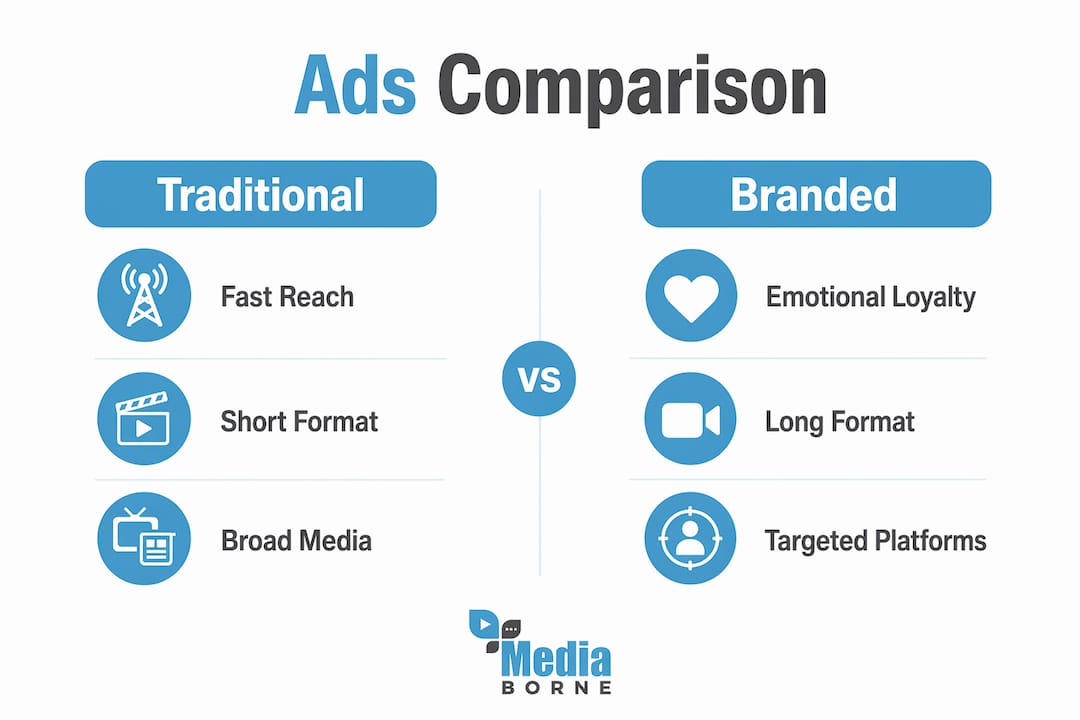
Traditional advertising is built for speed and scale. Formats are short by design: television commercials typically run 10 to 30 seconds, radio spots are similarly brief, and display ads must communicate in a glance. The creative brief for a traditional ad almost always includes a specific product, a price point or offer, and a deadline. The audience is expected to receive the message and act. There is no expectation of emotional investment.
Branded advertising operates on a different timescale. Brand films typically run between 60 and 180 seconds, and some of the most effective examples run longer. The Dove Real Beauty campaign, Nike's Dream Crazy film, and Patagonia's documentary content are not selling a specific product in a specific week. They are building a worldview that the audience chooses to associate with. Brand films outperform traditional ads in mid-to-bottom funnel metrics including engagement, completion rate, and brand trust, precisely because viewers opt in rather than tolerate the interruption.
The objectives behind each format break down as follows:
- Traditional advertising targets immediate awareness, promotional response, and short-cycle purchase decisions. It suits FMCG launches, retail promotions, and event-driven campaigns.
- Branded advertising targets brand preference, emotional resonance, and long-term loyalty. It suits high-consideration purchases, aspirational categories, and brands competing on identity rather than price.
- Format length reflects intent: traditional ads compress the message; branded content expands it.
- Audience relationship differs fundamentally: traditional ads interrupt, branded content invites.
- Creative ambition scales differently: traditional ads are often templated for efficiency; branded content is produced as a media asset with a lifespan beyond the campaign.
Understanding these objectives before briefing your agency or production partner is the single most important step in avoiding wasted spend.
How do media planning and targeting differ between the two approaches?
Media planning for branded advertising vs traditional follows different logic, and the distinction matters when you are allocating budget across channels.

Traditional advertising has historically relied on broad-reach media. Television, national press, and outdoor formats deliver large audiences at relatively low cost per contact. Audience selectivity varies across channels: a national TV spot reaches millions but cannot distinguish between your core buyer and someone who will never purchase. The trade-off is scale for precision. For brand launches or promotional campaigns where broad awareness is the goal, this is an acceptable trade.
Branded content in digital environments offers a different model. Platforms such as YouTube, TikTok, and connected TV allow you to target by interest, behaviour, and intent signal. A brand film placed against relevant content reaches a self-selected audience already predisposed to engage. The types of digital media consumption in 2026 show audiences spending more time in on-demand and social video environments, which means branded content now has the reach that once required a broadcast buy.
The table below summarises the key media planning differences:
| Factor | Traditional advertising | Branded advertising |
|---|---|---|
| Primary media channels | TV, radio, print, outdoor | YouTube, TikTok, connected TV, brand-owned platforms |
| Audience targeting | Broad demographic reach | Interest, behaviour, and intent-based targeting |
| Key performance metrics | CPM, cost per contact, reach | Brand recall, sentiment, memory association, watch time |
| Typical campaign duration | Short burst (days to weeks) | Extended or evergreen (months to years) |
| Content lifespan | Expires with the campaign | Functions as a long-term media asset |
The practical implication is that branded content can be planned as an asset rather than an expense. A well-produced brand film placed on YouTube continues to generate views, brand association, and search traffic long after the paid promotion period ends. Traditional ad creative rarely survives its campaign window.
What does the evidence say about effectiveness?
The effectiveness debate between branded and traditional advertising is often framed as either/or. The data suggests the real answer is sequencing and combination.
TV paired with search boosts brand recall by 8.7 times, and pairing TV with social media lifts recall by 1.8 times. This means traditional broadcast formats, when used as a memory foundation, dramatically amplify the performance of digital branded content. The two approaches are not competing; they are multiplying each other when planned together.
Branded content consistently delivers higher watch times and stronger brand loyalty metrics than traditional spots, particularly in categories where purchase decisions involve research and emotional investment. A consumer choosing a financial services provider, a car, or a holiday is not converted by a 15-second pre-roll. They are converted by accumulated brand preference built over time through storytelling.
Traditional advertising carries a specific risk that is often overlooked. Comparative ads risk brand confusion, with approximately one in five viewers attributing the ad to the competitor rather than the advertiser. The Ehrenberg-Bass Institute recommends brand-linkage testing before scaling any comparative creative. This is not a minor footnote. It means a significant portion of your traditional ad spend could be building your competitor's memory structure rather than your own.
Pro Tip: Before running any comparative or competitor-referencing traditional ad at scale, commission brand-linkage testing. The Ehrenberg-Bass Institute's research shows roughly 20% of viewers may credit the ad to the wrong brand, making pre-launch testing a non-negotiable step in the production process.
The KPI mismatch problem compounds this. Using the wrong metrics for branded content makes it appear ineffective even when it is building durable brand memory. Measuring a brand film by click-through rate is the equivalent of judging a documentary by ticket sales on opening night. The value accrues differently and over a longer period.
When should you choose branded over traditional advertising?
The choice between branded and traditional advertising is a strategic decision, not a creative preference. The right answer depends on your product category, your campaign objective, and where your audience sits in the purchase journey.
- Choose branded advertising when your product involves a high-consideration purchase decision. Financial services, automotive, travel, and premium consumer goods all benefit from emotional narrative because the buyer needs to trust the brand before they will commit.
- Choose traditional advertising when you need to drive immediate response. A limited-time retail promotion, a product launch with a specific date, or a seasonal offer all require the directness and speed of a traditional format.
- Combine both when you are building a market position over time while also needing to defend short-term revenue. Use brand films to establish identity and emotional preference, then use traditional spots to convert that preference into purchase during promotional windows.
- Consider your audience's media behaviour. Younger demographics spend the majority of their media time in social and on-demand environments where branded content performs well. Older demographics may still be reached more efficiently through broadcast and print.
- Assess your brand's current equity. A new brand with low awareness may need traditional advertising to establish basic recognition before branded content can do its work. An established brand with strong recall can invest more heavily in branded storytelling to deepen loyalty and defend against price competition.
Pro Tip: Map your campaign objective to the funnel stage before choosing a format. Branded content builds the top and middle of the funnel; traditional ads close the bottom. Running branded content at a moment when you need immediate sales, or running a promotional spot when you need to build trust, will produce disappointing results regardless of production quality.
For practical examples of how branded content drives engagement and conversion across different categories, the Media Borne blog covers real campaign structures in detail.
Key takeaways
Branded advertising builds long-term emotional equity through storytelling, while traditional advertising drives immediate response through direct promotion. The two formats require different KPIs, different media plans, and different creative briefs to deliver their intended outcomes.
| Point | Details |
|---|---|
| Core purpose differs | Branded ads build emotional loyalty; traditional ads drive immediate purchase response. |
| KPIs must match format | Measuring branded content by click-through rate undervalues its long-term memory impact. |
| TV multiplies branded recall | Pairing TV with search boosts brand recall by 8.7 times, making channel combination critical. |
| Comparative ads carry risk | Roughly one in five viewers may attribute a comparative ad to the competitor, not the advertiser. |
| Format choice follows funnel stage | Use branded content for consideration and loyalty; use traditional spots for conversion and promotion. |
Why I think most brands are using both formats wrong
After working across branded content and traditional advertising campaigns, the pattern I see most often is not that brands choose the wrong format. It is that they apply the wrong measurement framework to whichever format they choose, and then draw the wrong conclusions.
A brand invests in a beautifully produced brand film, measures it against direct response benchmarks, decides it "didn't work," and reverts to traditional spots. Six months later, their brand preference scores have dropped and they cannot understand why their promotional ads are converting at lower rates. The film was working. They just were not looking at the right numbers.
The reverse happens too. A brand runs traditional promotional spots continuously, builds short-term sales, and then finds that price sensitivity has increased because they have trained their audience to wait for offers rather than value the brand. Traditional advertising without branded content investment is a slow erosion of pricing power.
The brands that get this right treat branded content as infrastructure, not campaign spend. They produce brand films as long-term assets, place them in environments where the right audience will find them organically, and use traditional advertising to amplify and convert the preference those films have built. Comcast's 2026 research on TV as a memory builder reinforces this: in an era where AI search summaries are reducing organic brand recall, broadcast formats that build memory structures are becoming more valuable, not less.
My recommendation: before your next campaign brief, write down the single metric that will tell you whether the campaign succeeded. If that metric does not match the format you are planning to use, change one of them.
— Stephen
How Media Borne helps brands produce advertising that actually works
Media Borne produces brand films, advertising campaign videos, and entertainment-led content designed to perform across both branded and traditional advertising formats. Whether you need a long-form brand story that builds emotional equity over time or a high-impact campaign video built for conversion, the production and strategy teams at Media Borne align creative decisions to measurable outcomes from the first brief.
If you are ready to produce content that functions as a long-term media asset rather than a single-use campaign, explore Media Borne's professional video production services. You can also review the campaign video portfolio to see how branded and traditional formats have been executed for real brands.
FAQ
What is the main difference between branded and traditional advertising?
Branded advertising uses storytelling and emotional narrative to build long-term brand loyalty, while traditional advertising uses direct promotion and calls to action to drive immediate purchase response. The two formats serve different funnel stages and require different performance metrics.
Which type of advertising has better ROI?
Neither format universally outperforms the other. Branded content delivers stronger long-term brand equity and loyalty metrics, while traditional advertising produces faster short-term sales response. Combining TV with search boosts brand recall by 8.7 times, making a combined approach the most effective strategy for most brands.
How do you measure the effectiveness of branded advertising?
Branded advertising is best measured through brand recall, sentiment shift, memory association scores, and watch time rather than click-through rate or direct conversions. Mismatched KPIs are the most common reason branded content appears to underperform despite building genuine long-term value.
Are comparative traditional ads risky?
Yes. Research from the Ehrenberg-Bass Institute shows roughly one in five viewers may attribute a comparative ad to the competitor rather than the advertiser. Brand-linkage testing before scaling any comparative creative is strongly recommended.
When should a brand invest in branded content over traditional ads?
Branded content is the stronger investment for high-consideration categories, aspirational products, and brands competing on identity rather than price. Traditional advertising suits promotional campaigns, product launches with specific dates, and situations where immediate conversion is the primary objective.