
TL;DR:
- The creative ideation process is a structured method that transforms vague briefs into testable, innovative concepts through phases like empathy, definition, and evaluation. Managing distinct divergent and convergent thinking modes with clear signals and techniques ensures effective idea generation and selection. Proper preparation, explicit mode switching, and in-session synthesis significantly improve campaign outcomes and idea progression.
The creative ideation process is the systematic method by which teams generate, develop, and refine ideas to fuel innovative content and marketing campaigns. In practice, it combines structured frameworks such as design thinking and SCAMPER with facilitated workshop techniques like Crazy 8s and brainwriting to move from a vague brief to a pipeline of testable concepts. For creative professionals and marketers, understanding this process is the difference between campaigns built on genuine insight and those built on gut instinct alone. This explainer covers the core stages, thinking modes, practical techniques, and common pitfalls you need to know.
What is the creative ideation process?
The creative ideation process is a structured, repeatable sequence for generating and developing ideas. It is not a single brainstorm. It is a series of deliberate phases that move a team from problem framing through to validated, production-ready concepts.

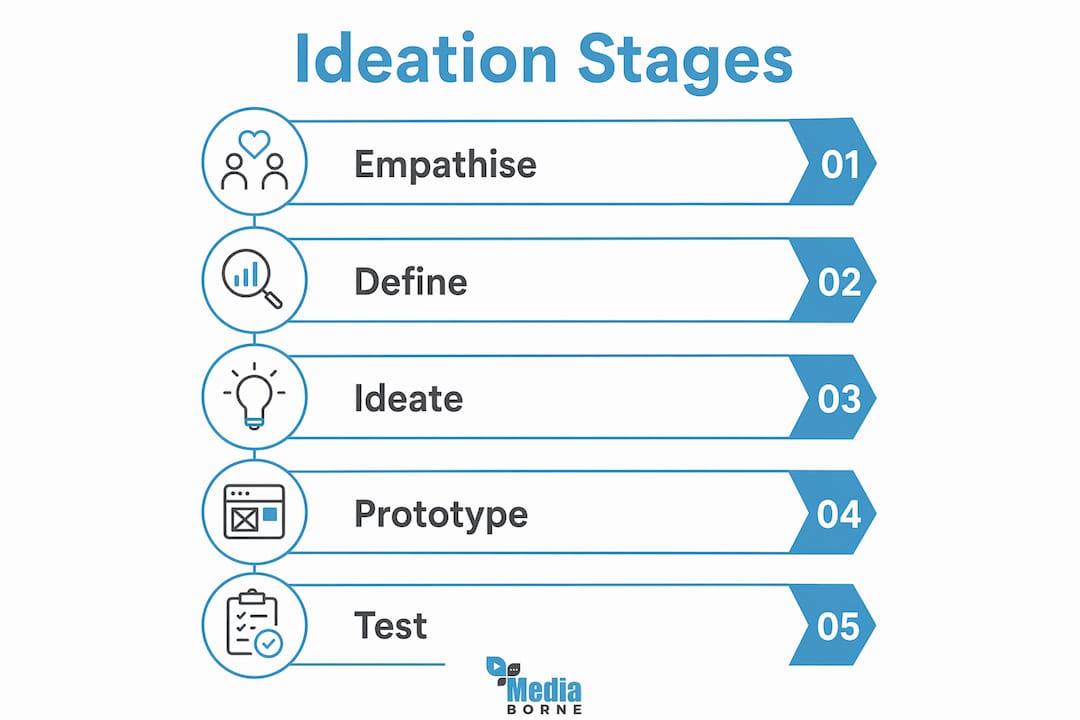
The most widely used framework is design thinking, which organises the process into five stages: Empathise, Define, Ideate, Prototype, and Test. Each stage has a distinct purpose. Empathise gathers audience insight. Define sharpens the problem. Ideate generates multiple directions. Prototype makes concepts tangible. Test validates before you commit budget.
A complementary model comes from psychologist Graham Wallas, whose four-stage creativity model describes Preparation, Incubation, Illumination, and Verification. This model adds a cognitive dimension that design thinking alone does not cover. It explains why stepping away from a problem often produces the best ideas. Both frameworks are worth understanding because they address different aspects of the same creative challenge.
What are the core stages of ideation?
The five stages of design thinking map directly onto campaign development workflows for marketing teams. Here is how each stage functions in practice:
- Empathise: Conduct audience research, review social listening data, and gather customer feedback. This stage produces the raw material that makes ideation relevant rather than generic.
- Define: Write a clear problem statement. The best format is: "How might we [achieve X] for [audience Y] so that [outcome Z]?" A sharp problem statement is the single most important input to any ideation session.
- Ideate: Generate multiple creative directions without judgement. Volume is the goal at this stage, not quality.
- Prototype: Translate the strongest ideas into rough, testable formats. For marketers, this might mean a storyboard, a landing page mock-up, or a short video treatment.
- Test: Expose prototypes to a real or representative audience and gather structured feedback before scaling.
Spending sufficient effort on the Empathise and Define stages is the key unlock for marketers. Teams that skip straight to ideation often solve the wrong problem entirely. A sharply framed audience problem is what separates a productive ideation session from an hour of unfocused discussion.
How do divergent and convergent thinking shape ideation?
Divergent and convergent thinking are the two cognitive modes that every ideation session must manage explicitly. Divergent thinking is idea generation without judgement. It prioritises fluency, flexibility, and originality. Convergent thinking is evaluation, selection, and synthesis. It applies defined criteria to identify the strongest ideas.
The critical operational rule is to keep these modes separate. When a team evaluates ideas during the generation phase, it collapses idea volume and creates analysis paralysis. When a team generates endlessly without ever converging, it produces raw inputs that never progress. The biggest operational mistake in ideation is failing to manage this switch.
A well-structured session makes the mode switch explicit. You might run 20 minutes of silent divergent generation, then shift into a clearly signalled convergent phase where the team clusters, scores, and selects. The facilitator's job is to protect each mode from the other. This is not a soft preference. It is the structural condition that determines whether a session produces usable output.
Pro Tip: Use a physical or digital signal to mark the mode switch. A timer, a change of tool (from sticky notes to a scoring matrix), or even a verbal announcement all work. The signal prevents the group from slipping back into generation when they should be evaluating.
What ideation techniques work best in workshops?
The most effective ideation sessions combine multiple techniques across divergent and convergent phases. The choice of technique depends on the stage of the process and the type of output you need.
Techniques for divergent generation
Crazy 8s is the most reliable technique for generating volume quickly. Each participant sketches 8 ideas in 8 minutes. Ideas 6 through 8 tend to be the most unusual and genuinely creative. The time pressure forces participants past their first, safest instincts.
Brainwriting is a silent variation of group brainstorming. Participants write ideas on paper and pass them around the table, building on each other's thinking without the social pressure of speaking aloud. This technique is particularly effective in groups where a few loud voices tend to dominate.
Mind mapping works well for exploring a theme before committing to a direction. A central concept sits at the centre, with branches extending into related ideas, associations, and questions.
Techniques for framing and questioning
Starbursting generates 20–30 research-ready questions about the core challenge before any solution ideation begins. Teams use the six Ws (Who, What, Where, When, Why, How) with a 15-minute timer. This technique prevents teams from solving the wrong problem and surfaces assumption gaps early.
SCAMPER is a checklist that prompts teams to view an existing idea from seven distinct perspectives: Substitute, Combine, Adapt, Modify, Put to other uses, Eliminate, and Reverse. Time-boxed prompts of 3–5 minutes per lens help surface multiple directions, especially when applied to concrete campaign elements like a format, a channel, or a message.
Comparing key techniques
| Technique | Primary Purpose | Time Needed | Output Type |
|---|---|---|---|
| Crazy 8s | Rapid volume generation | 8 minutes | Sketched idea artefacts |
| Starbursting | Problem framing and questioning | 15 minutes | Research-ready question clusters |
| SCAMPER | Idea variation and expansion | 20–35 minutes | Multiple creative directions |
| Brainwriting | Silent collaborative generation | 15–20 minutes | Written idea cards |
| Mind mapping | Theme and concept exploration | 20–30 minutes | Visual idea map |
The synthesis phase is what most teams skip and what most sessions need most. A 90-minute structured session that ends with in-room clustering, voting, and assigned ownership converts raw ideas into pipeline-ready concepts. Skipping synthesis means your team leaves with a wall of sticky notes and no clear next step.
How do you apply ideation to marketing campaigns?
Translating ideation theory into campaign practice requires a clear workflow. The steps below map design thinking directly onto a content or campaign development process.
- Gather audience insight. Pull social listening data, customer interviews, and platform analytics before the session. Brief participants in advance so the session starts with shared context, not a 30-minute catch-up.
- Write a problem statement. Use the "How might we" format. Circulate it before the session and refine it as a group at the start. A clear problem statement is the single biggest driver of session quality.
- Run divergent bursts with varied prompts. Repeated time-boxed bursts with different prompts reduce fixation on safe ideas and generate diverse options across content formats and audience segments. Run at least two or three rounds before converging.
- Converge and cluster. Group ideas by theme. Use dot voting or a scoring matrix to identify the strongest directions. Aim to leave with three to five distinct creative territories.
- Assign ownership and prototype. Each selected idea needs an owner and a deadline for a rough prototype. For campaign work, this might be a one-page creative brief, a storyboard, or a short video treatment.
- Test before scaling. Pilot the strongest concept with a small audience segment before committing full production budget. Use the feedback to refine, not to restart.
The main bottleneck in campaign workflows is converting verbal brainstorm outputs into structured idea cards with owners and deadlines. Teams that build this conversion step into the session itself, rather than treating it as a follow-up task, see far higher rates of idea progression. For content teams working across social media campaigns, this structured approach also makes it easier to brief production partners with clarity and confidence.
Pro Tip: Create a simple idea card template before the session. Each card should capture the idea in one sentence, the target audience, the proposed format, and the owner. Filling these in during synthesis takes five minutes per idea and prevents the most common post-session failure: nobody knows what happens next.
Key takeaways
The creative ideation process works best when divergent generation, convergent evaluation, and in-session synthesis are treated as three distinct, non-negotiable phases.
| Point | Details |
|---|---|
| Start with a sharp problem statement | Use the "How might we" format to frame the challenge before any idea generation begins. |
| Separate thinking modes explicitly | Keep divergent generation and convergent evaluation in distinct, timed phases to protect idea volume and quality. |
| Use structured techniques | Crazy 8s, SCAMPER, and Starbursting each serve different purposes; combine them across a single session. |
| Synthesise before you leave the room | Assign ownership and next steps during the session itself to prevent ideas from stalling after the workshop. |
| Test before scaling | Prototype the strongest concepts and pilot them with a real audience before committing full production budget. |
Why most ideation sessions fail before they start
I have facilitated ideation sessions for brands across entertainment, retail, and media, and the failure mode is almost always the same. Teams arrive without a shared problem statement, spend the first 30 minutes aligning on context, and then rush the actual generation phase because time is running out. The session ends with a wall of ideas and no clear owner for any of them.
The fix is not a better technique. It is better preparation and a non-negotiable synthesis step. The teams I have seen produce the strongest campaign concepts are not the ones with the most creative individuals in the room. They are the ones with the clearest brief going in and the most disciplined process for converting raw ideas into structured next steps coming out.
Mode switching is the other thing most facilitators underestimate. Protecting the divergent phase from premature evaluation is genuinely difficult in a room full of experienced marketers who are used to making quick judgements. You have to be explicit about it. Name the mode. Signal the switch. Enforce the rule. When you do, the quality of ideas in the convergent phase is noticeably higher because the generation phase was allowed to run properly.
The Wallas model is also worth revisiting. Incubation is not a luxury. Scheduling a second session 24–48 hours after the first divergent burst consistently produces stronger convergent outputs than trying to do everything in one sitting. Build that gap into your process wherever the timeline allows.
— Stephen
Bring your best ideas to life with media borne
The gap between a great ideation session and a great campaign is production quality. Media borne's video production services are built to take the creative territories you develop in the workshop and turn them into polished, high-impact content for TikTok, YouTube, and beyond.
Whether you are prototyping a new content format or scaling a campaign that has already been tested, Media borne combines production expertise with marketing strategy to make your ideas perform. If you want to see how structured ideation connects to advertising campaign videos that actually convert, the team at Media borne is ready to help you move from concept to camera.
FAQ
What is the creative ideation process?
The creative ideation process is a structured sequence of stages for generating, developing, and selecting ideas. It typically follows design thinking phases: Empathise, Define, Ideate, Prototype, and Test.
What is the difference between divergent and convergent thinking?
Divergent thinking generates ideas without judgement, prioritising volume and originality. Convergent thinking evaluates and selects the strongest ideas using defined criteria. Effective sessions keep these modes explicitly separate.
How long should an ideation workshop be?
A well-structured ideation session runs for approximately 90 minutes, covering silent generation, sharing, clustering, voting, and in-room synthesis. Synthesis before the session ends is the step most teams skip and most need.
What is SCAMPER in creative brainstorming?
SCAMPER is a checklist technique that prompts teams to view an idea from seven angles: Substitute, Combine, Adapt, Modify, Put to other uses, Eliminate, and Reverse. Time-boxed prompts of 3–5 minutes per lens help generate multiple creative directions quickly.
How do you stop good ideas from being lost after a workshop?
Assign each selected idea an owner and a deadline during the session itself. A simple idea card capturing the concept, target audience, format, and owner takes five minutes to complete and prevents post-session stalling.